Showing posts with label Bolivia. Show all posts

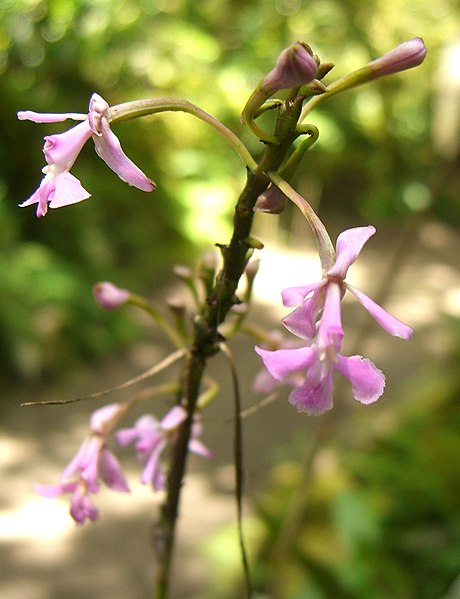
Epidendrum yungasense

Epidendrum yungasense

Native to: Bolivia. Epidendrum yungasense grows on trees in mountain forests between 1700 and 1900 meters in elevation.
Plant Size: Medium?
Flower Size: 1 inch (2.5 cm)
Flower Description: Flowers are produced on a terminal inflorescence.
Bloom Season: Spring?
Growing Temperature: Warm
Additional Information: Grow mounted on cork or tree fern. Mist and water regularly.
Synonyms: None.

Epidendrum tridactylum

Epidendrum tridactylum

Common Name: Three-fingered Epidendrum Orchid
Native to: Mexico south to Panama, Peru, Ecuador, Bolivia. Epidendrum tridactylum grows on rock-strewn slopes in wet forests near 1900 meters in elevation. This species is a terrestrial plant.
Plant Size: Medium. Epidendrum tridactylum has reed-like stems that have four or five leaves.
Flower Size: 0.5 inches (1.5 cm)
Flower Description: The flowers of Epidendrum tridactylum are produced on a branched inflorescence. The color of the flowers is highly variable.
Bloom Season: Spring
Growing Temperature: Warm to Cool
Additional Information: Grow Epidendrum tridactylum in well-drained pots with terrestrial orchid mix. Keep moist year-round and provide humid growing conditions. It is adaptable to many growing temperatures.
Synonyms: Amblostoma cernua, Amblostoma densum, Amblostoma dusenii, Amblostoma tridactylum, Epidendrum amblostoma

Epidendrum ruizianum

Epidendrum ruizianum

Common Name: Ruiz's Epidendrum
Native to: Bolivia, Columbia, Ecuador, Peru, Venezuela. Epidendrum ruizianum grows on trees or as a terrestrial plant in cool forests. It grows on steep, rocky slopes where it is exposed to the elements from 1200 to 3000 meters in elevation.
Plant Size: Large. Epidendrum ruizianum has reed-like stems that have many leaves.
Flower Size: 0.75 inches (2 cm)
Flower Description: The flowers of Epidendrum ruizianum are produced on a 6 inch (15 cm) terminal flower stem that has many flowers clustered at the tip. The flower stem can be branched. Flowers are fragrant and open over a long period of time.
Bloom Season: Late Summer to Winter (August to March in its native habitat).
Growing Temperature: Cool
Additional Information: Epidendrum ruizianum was named in honor of Dr. Ruiz who was a highly regarded botanist from the 18th century. Do not confuse this species with Encyclia nutans which is unique. Grow in pots with terrestrial orchid mix or mount on cork bark. Provide cool growing conditions and bright light.
Synonyms: Epidendrum dipus, Epidendrum nutans, Epidendrum spathaceum

Epidendrum quinquepartitum

Epidendrum quinquepartitum

Common Name: Five-lobed Epidendrum Orchid
Native to: Bolivia.
Plant Size: Medium
Flower Size: Small
Flower Description: The flowers of Epidendrum quinquepartitum are produced on a pendant, terminal inflorescence. The lip has five lobes.
Bloom Season: Fall to Winter
Growing Temperature: Warm to Cool
Additional Information: Epidendrum quinquepartitum was first described in 1922. Grow mounted on cork bark slabs or grow in a slatted basket. Provide even water and fertilizer throughout the year.
Synonyms: None.

Epidendrum ionodesme

Epidendrum ionodesme

Native to: Columbia, Peru, Ecuador, and Bolivia. Epidendrum ionodesme grows on disturbed soil as a terrestrial plant. It is reported to be common on road cuts and other disturbed areas.
Plant Size: Large
Flower Size: 1 inch (2.5 cm)
Flower Description: Flowers are violet in color and born in clusters.
Bloom Season: Spring to Fall
Growing Temperature: Cool
Additional Information: Epidendrum ionodesme grows best in a pot with well-drained terrestrial orchid growing mix. Provide cool, humid conditions. The flower color is attractive. There is some confusion about the proper botanical name for this species and some sources erroneously call it Epidendrum porphyreum.
Synonyms: Epidendrum porphyreum

Epidendrum funckii

Epidendrum funckii


Common Name: Funk's Epidendrum
Native to: Bolivia, Columbia, Ecuador, and Peru. Epidendrum funckii is found growing in moist mountainous cloud forests on steep, exposed slopes. The plants grow as terrestrial orchids.
Plant Size: Medium. Epidendrum funckii has pseudobulbs with several leaves.
Flower Size: 2.5 inches (6 cm)
Flower Description: Flowers are large and conspicuous and bloom on a 24 inch (60 cm) long, erect flower spike. Each mature growth produces few to many flowers.
Bloom Season: Anytime of the year.
Growing Temperature: Warm to Cool (Adaptable)
Additional Information: This interesting species grows well in pots that have terrestrial orchid mix. Keep on the moist side but avoid over-watering. This species grows well in a Cattleya greenhouse but is adaptable to many different growing regiments.
Synonyms: Epidendrum brachycladium, Epidendrum brachycladium var. crassipes, Epidendrum crassipes, Epidendrum crassipes, Epidendrum dolabrilobum, Epidendrum funckii, Epidendrum pachypodum, Epidendrum blepharoclinium

Epidendrum friderici-guilielmi

Epidendrum friderici-guilielmi

Common Name: The Kaiser Fredrich Wilheim II Epidendrum
Native to: Peru and Bolivia. Epidendrum friderici-guilielmi grows in cloud forests from 2000 to 3000 feet in elevation. It grows on trees and rocks.
Plant Size: Large. Epidendrum friderici-guilielmi has upright, reed-like stems that have four or five leaves.
Flower Size: 4 inches (10 cm)
Flower Description: Epidendrum friderici-guilielmi has large, showy flowers that are produced on a 10 inch (25 cm) long flower stem that has several to many flowers. Flowers open over a long period of time.
Bloom Season: Any time of year.
Growing Temperature: Warm to Cool
Additional Information: The large flowers of Epidendrum friderici-guilielmi make it an attractive species for Epidendrum collectors. Grow mounted on cork or in slatted baskets or pots with good drainage. Provide even moisture and nutrition throughout the year.
Synonyms: Epidendrum huacapistanae, Spathium friederici-guilelmi

Epidendrum fimbriatum - Fringed Epidendrum

Epidendrum fimbriatum 

Common Name: Fringed Epidendrum
Native to: Venezuela, Columbia south to Peru and east to Bolivia. Epidendrum fimbriatum grows on trees or as a terrestrial plant in wet mountain forests from 1100 to 3700 meters in elevation.
Plant Size: Small. Epidendrum fimbriatum has slender, branched, leafy stems that have narrow leaves.
Flower Size: 0.25 inches (6 mm)
Flower Description: Flowers are small and fringed. Few flowers are produced on a generally unbranched flower stem that emerges from mature stems. The small, delicate flowers open over a long period of time.
Bloom Season: Epidendrum fimbriatum can bloom almost anytime of the year.
Growing Temperature: Cool
Additional Information: Grow mounted on cork or tree fern or grow in a pot with excellent drainage. The fringed flowers are attractive and delicate and bloom when you least expect it. Provide cool, humid growing conditions and give ample water when stems are growing.
Synonyms: Epidendrum alternans, Epidendrum fimbriatum var. rhomboglossum, Epidendrum integrilabium, Epidendrum rhomboglossum

Epidendrum coriifolium - Leather-Like Leaf Epidendrum

Epidendrum coriifolium

Common Name: Leather-Like Leaf Epidendrum

Native to: Mexico and Central America south to Bolivia, Peru, and Venezuela. Epidendrum coriifolium grows in wet tropical and subtropical mountain forests from 350 to 1500 meters in elevation. It can grow on trees, rocks, or in the ground as a terrestrial orchid.

Plant Size: Medium. Epidendrum coriifolium has reed-like stems that have green leaves with purple undersides.

Flower Size: 1.5 to 2 inches (4-5 cm)

Flower Description: The flowers are large and attractive but have a rather unpleasant fragrance. A few to several large purple flowers are produced on a 10 inch (25 cm) tall flower stem that emerges from freshly maturing pseudobulbs.

Bloom Season: Winter.

Growing Temperature: Warm to Cool (Adaptable)

Additional Information: Epidendrum coriifolium is a widespread and adaptable species that is easy to grow mounted on cork or in pots. Provide even moisture and fertilizer throughout the year.

Synonyms: Epidendrum fuscopurpureum, Epidendrum imitans, Epidendrum magnibracteatum, Epidendrum palmense, Epidendrum subviolascens

Epidendrum compressum - Compressed Epidendrum

Epidendrum compressum

Common Name: Compressed Epidendrum

Native to: Bolivia, Columbia, Ecuador, Peru, Venezuela, Trinidad. Epidendrum compressum grows on trees in wet mountainous forests. It's habitat ranges from 110 meters to 1700 meters in elevation.

Plant Size: Small. Compact plants of Epidendrum compressum have fleshy stems with up to four leaves.

Flower Size: 0.25 inches (1 cm)

Flower Description: Flowers of Epidendrum compressum are small and bloom on an arching flower stem that grows up to 16 inches (40 cm) long.

Bloom Season: Winter to Early Spring

Growing Temperature: Warm

Additional Information: Grow Epidendrum compressum mounted on cork or tree fern or in a pot with coarse open media. Provide warmth, humidity, and constant moisture and nutrition throughout the year. The species was first described to the scientific community in 1864.

Synonyms: Epidendrum guentherianum, Epidendrum laxum, Epidendrum macrothyrsis, Epidendrum yatapuense, Minicolumna laxa, Minicolumna yatapuensis

Epidendrum cochabambanum - Cochabamba Epidendrum

Epidendrum cochabambanum

Common Name: Cochabamba Epidendrum

Native to: Epidendrum cochabambanum is native to Ecuador, Peru, and Bolivia where it grows on trees between 170 to 2400 meters in elevation.

Plant Size: size

Flower Size: size

Flower Description: description

Bloom Season: Fall

Growing Temperature: Warm to Cool

Additional Information: Epidendrum cochabambanum is named after a city in Bolivia where the species has been collected.

Synonyms: None.

Epidendrum calanthum

Epidendrum calanthum

Common Name: Beautiful Blooming Epidendrum

Native to: Bolivia, Columbia, Ecuador, Venezuela, Peru. This widespread species grows in a wide variety of habitats and is very adaptable to local conditions. Epidendrum calanthum grows on either trees or as a terrestrial plant in tropical mountain forest from 220 to 2200 meters in elevation.

Plant Size: Medium to Large. The stems are reed-like and leafy.

Flower Size: 1 inch (2.5 cm)

Flower Description: The colorful flowers bloom on an 8 inch (20 cm) tall stem that produces many flowers that open over a long period of time. Flower stems emerge from recently matured reed-stems.

Bloom Season: Spring to Summer

Growing Temperature: Cool

Additional Information: Epidendrum calanthum is widespread and adaptable and easy to cultivate if its needs are met. Provide high humidity and ample water with bright light. Grow in a pot with a course, free-draining growing media. There are many color forms available in the trade and they are worth seeking out for specialty growers.

Synonyms: Epidendrum caucae, Epidendrum chrysostomum, Epidendrum decipiens, Epidendrum filomenoi, Epidendrum huanucoense, Epidendrum ibaguense var. confluens, Epidendrum laetum, Epidendrum paytense, Epidendrum pristes, Epidendrum schomburgkii var. confluens

Epidendrum armeniacum - The Orange Epidendrum

Epidendrum armeniacum

Common Name: The Orange Epidendrum

Native to: Bolivia, Brazil, Ecuador, and Peru. Epidendrum armeniacum grows in moist mountainous forests between 450 and 1600 meters in elevation. This species grows on tree trunks.

Plant Size: Small. The stems are slender and upright and have many leaves.

Flower Size: 0.75 inches (2 cm)

Flower Description: Orange flowers are produced in great quantity on a flower stalk that emerges from the top of mature canes. Colorful and attractive.

Bloom Season: Fall and Winter

Growing Temperature: Warm to Cool (Adaptable)

Additional Information: Epidendrum armeniacum is an attractive and floriferous compact species that is adaptable and fairly undemanding. Mount on cork or tree fern or grow in pots with a loose, open media. Keep moist but not soggy and provide humidity and air circulation. This species has been used to produce some of todays showy reed-stem Epidendrum orchid hybrids.

Synonyms: Amblostoma armeniacum, Epidendrum macrostachya

Epidendrum anderssonii - Andersson's Epidendrum

Epidendrum anderssonii

Common Name: Andersson's Epidendrum

Native to: Bolivia, Columbia, Ecuador, and Peru. Epidendrum anderssonii is a terrestrial orchid species that grows in cool, moist mountain habitats between 2600 to 2700 meters in elevation.

Plant Size: Large. The plants have upright cane-like stems clothed with many leaves. The stems can develop branches.

Flower Size: Tiny. 0.5 cm

Flower Description: Flowers are produced on short flower stems at the tip of the canes. A few flowers are produced on each stem.

Bloom Season: Blooms throughout the year.

Growing Temperature: Cool

Additional Information: This species was named in honor of Mr. Andersson who is a collector of Ecuadorian orchid species.

Synonyms: Epidendrum inamoenum var. robustum

Encyclia thrombodes - Pflanz's Encyclia

Encyclia thrombodes

Common Name: Pflanz's Encyclia

Native to: Bolivia, Brazil, Columbia, Peru. Encyclia thrombodes has been discovered growing near Villa Montes, Bolivia.

Plant Size: Medium. Leaves grow 8 to 14 inches (25-35 cm) long and 1 inch (2.5 cm) wide.

Flower Size: 1.5 inches (3 cm)

Flower Description: The flowers of Encyclia thrombodes are green washed with brown. Petals and sepals are pointed. The lip is spade shaped, white, and has rose markings. Many flowers are produced on a tall, branched flower stem that blooms amongst the leaves.

Bloom Season: Summer?

Growing Temperature: Intermediate

Additional Information: This species is the most southern member of the genus and grows on trees. Grow mounted and provide typical Cattleya growing conditions.

Synonyms: Epidendrum thrombodes, Encyclia pflanzii

Schomburgkia moyobambae

Schomburgkia moyobambae

Native to: Bolivia and Peru.

Plant Size: Large. Schomburgkia moyobambae is a large plant with fusiform pseudobulbs. Each growth has two tongue-shaped dark green leaves.

Flower Size: 1.5 inches (4 cm)

Flower Description: Schomburgkia moyobambae has rose colored petals and sepals. Many flowers are clustered at the tip of a 36 inch (1 m) long arching flower spike. Mature plants can have 20 to 25 flowers on each blooming growth.

Bloom Season: Spring

Growing Temperature: Warm

Additional Information: Schomburgkia moyobambae is a warm to hot growing species that needs a slatted wood basket or driftwood mount for best results. Water daily during the summer and periods of active growth, less in winter. Provide more light than Cattleya orchids prefer. Robust.

Synonyms: Laelia moyobambae

Brassavola tuberculata

Brassavola tuberculata

Common Name: Rough or Tuberculated Brassavola
Native to: Brassavola tuberculata is native to Brazil, Paraguay and Bolivia where it grows on trees in the hot, humid savannahs.

Plant Size: Medium. Brassavola tuberculata has narrow, cylindrical pseudobulbs and narrow, terete leaves. Stems are somewhat pendent.

Flower Size: 2.5 inches to 3 inches

Flower Description: The petals and sepals are green in color. The lip is white with a solid margin.

Bloom Season: Late Spring, Early Summer

Growing Temperature: Warm, Intermediate

Additional Information: Brassavola tuberculata grows best mounted on cork bark mounts. Provide lots of water during the growing season and less during the winter.

Synonyms: Bletia tuberculata; Brassavola fragrans; Brassavola gibbsiana; Brassavola trinervis; Brassavola tuberculata; Tulexis bicolor

Brassavola perrinii

Brassavola perrinii

Common Name: Perrin's Brassavola

Native to: Brassavola perrinii is found growing in Bolivia, Paraguay, Brazil, and Argentina.

Plant Size: Small to Medium. Brassavola perinii is pendent and the leaves and pseudobulbs droop. The leaves are fleshy and terete and the pseudobulbs are narrow and cylindrical.

Flower Size: 2.5 to 5 inches

Flower Description: The flowers of Brassavola perinii are star-shaped with narrow, pointed olive green petals and sepals. The lip is white and broad and heart-shaped. Flowrs are fragrant. Flowers of Brassavola perrinii grow on a short flower spike and three to six flowers bloom on each inflorescence.

Bloom Season: Spring, Summer

Growing Temperature: Warm to Hot

Additional Information: This species is quite attractive and grows well mounted on cork, wood, or tree fern plaques. Provide ample water and fertilizer during the growing season and reduce water during the cooler winter months. Provide bright light, good air circulation, and high humidity.

Synonyms: Brassavola fragrans

Brassavola martiana

Brassavola martiana


Native to: Brassavola martiana is native to Guyana in northern South America. It is also found growing at low elevations in Bolivia, Brazil, Surinam, the Guyanas, Venezuela and Colombia below 1000 meters. It grows on trees.

Plant Size: Medium to large. Brassavola martiana has pencil-like pseudobulbs and terete, fleshy leaves that have a shallow v-shaped channel that runs down the center of the leaf. The leaves are longer than Brassavola ceboletta but shorter than Brassavola cucullata. Foliage is dark green or olive green in color. The plants are upright.

Flower Size: Small. Flowers range from one inch to three inches across.

Flower Description: The scent of Brassavola martiana is small but powerfully fragrant. The scent of Brassavola martiana has been described as very floral with hints of jasmine and gardenia. The petals and sepals are olive green. The lip is small and spade-shaped with a frilly margin. Flowers are long-lived and fragrant at night.

Bloom Season: Spring

Growing Temperature: Warm, Intermediate

Additional Information: Brassavola martiana grows best mounted on wood, a tree branch, or cork plaque. Reduce watering during the cooler months of the year and provide copious water and fertilizer while new growth is developing.
Synonyms: Bletia amazonica; Bletia attenuata; Brassavola angustata; Bletia martiana; Brassavola amazonica; Brassavola angustata; Brassavola duckeana; Brassavola multiflora; Brassavola martiana var. multiflora; Brassavola surinamensis